Two loans, both advertised at "1.5% interest." One costs you $9,000 in total interest; the other costs $16,000. How is that possible?
The answer lies in the difference between flat rate and effective interest rate—a distinction that confuses even experienced business owners. Understanding how each works is essential for comparing loan offers accurately and avoiding expensive surprises.
Flat rate explained
A flat rate calculates interest on the original principal for the entire loan tenure, regardless of how much you have already repaid.
The calculation is simple: Principal multiplied by Rate multiplied by Number of Months. This simplicity is part of its appeal—anyone can calculate the total interest in seconds.
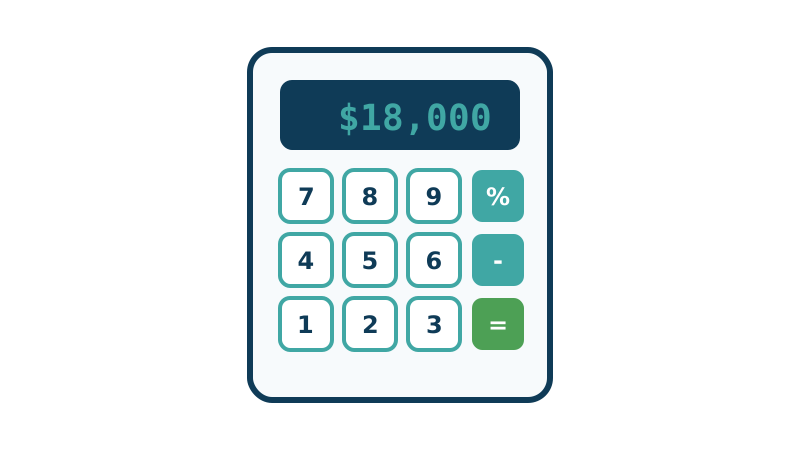
Consider a $100,000 loan at 1.5% flat monthly for 12 months. The total interest is $100,000 times 1.5% times 12, which equals $18,000. Your monthly payment would be approximately $9,833 (principal plus interest divided by 12 months).
The catch is subtle but significant: you are paying interest on money you have already repaid. After six months, you have returned roughly $50,000 in principal. But your interest calculation still applies 1.5% to the original $100,000, not to the $50,000 you still owe.
Flat rates are common in Singapore SME lending because they are easy to understand and quote. The advertised number appears lower than the true cost of borrowing, which makes loans seem more attractive in comparison to other financial products.
Effective interest rate explained
The effective interest rate, sometimes called EIR or reducing balance rate, calculates interest on the outstanding balance at each point in time.
As you repay principal, the amount you owe decreases, and so does the interest charge. In the early months, when your balance is highest, you pay more interest. In later months, as the balance shrinks, interest charges fall correspondingly.
This is how mortgages and many bank products calculate interest. It reflects the true annual cost of borrowing because it accounts for the reducing nature of loan balances over time.
If you wanted to pay approximately $18,000 in total interest on a $100,000 loan over 12 months using a reducing balance method, the quoted annual rate would be much higher—somewhere around 30% per annum. This sounds alarming, but it produces the same total interest payment as the 1.5% monthly flat rate.
The EIR matters because it allows comparison across different loan structures. When one lender quotes flat and another quotes reducing balance, the raw numbers are not comparable without conversion.
The conversion you need to know
Converting between flat rate and effective interest rate requires understanding that they measure different things. As a rough approximation: monthly flat rate multiplied by 1.8 to 2.0 gives you the approximate annual EIR.
This means:
A 1.0% monthly flat rate converts to approximately 18-20% EIR per annum. A 1.5% monthly flat rate converts to approximately 27-30% EIR per annum. A 2.0% monthly flat rate converts to approximately 36-40% EIR per annum.
These EIR figures sound high compared to mortgage rates or credit card APRs. But the comparison is misleading without context. SME working capital loans are unsecured, short-term, and involve higher operational costs per dollar lent than large property-backed mortgages. The risk profile and economics are fundamentally different.
What matters is that you can now compare across structures. If Lender A offers 1.5% monthly flat and Lender B offers 28% annual EIR, you know these are roughly equivalent in total interest cost. The decision should turn on other factors: fees, flexibility, speed, and service.
Beyond the rate: total cost comparison
Smart comparison requires looking beyond the interest rate entirely and calculating total cost.
Start with total interest paid over the full tenure. Then add all fees: processing fees, administrative charges, legal costs if applicable, and any required insurance premiums. Subtract any rebates or incentives—some lenders return processing fees for good payment behaviour or provide interest rebates for early settlement. Finally, factor in early repayment penalties if there is any chance you might settle the loan ahead of schedule.
Two loans with identical interest rates can have very different total costs once fees are included. A loan at 1.5% flat with a 5% processing fee and no rebates costs more than a loan at 1.6% flat with a 5% processing fee and a 50% rebate for perfect payment.
Run the full calculation. Do not let the headline rate make your decision.
Questions to ask your lender
Before committing to any business loan, ask these questions:
Is this a flat rate or a reducing balance rate? If flat, what is the equivalent EIR so I can compare with other products? What fees apply, and when are they charged? Are there any rebates available for good payment behaviour or early settlement?
The answers let you calculate true total cost and compare offers on equal terms.
Key takeaway
Understanding the math empowers better decisions. Flat rate and effective interest rate are simply different ways of expressing borrowing cost—neither is inherently better or worse. What matters is that you know which one you are looking at and can calculate total cost across all the loans you are comparing.
If you want a clear breakdown of your financing cost in terms you can compare, apply with Credezo for a transparent offer that shows exactly what you will pay.